
Grey might not be the first colour you associate with the brightness and sparkle of fine jewellery, however there are many gemstones that have grey varieties. The market for coloured stones is more varied than it’s ever been and there is strong demand for non-traditional colours, which has seen grey spinels become a trend in the gemstone world.
Spinels are a gemstone that comes in many colours and it’s their exceptional clarity and high lustre when polished that makes them the perfect backdrop for the subtle charms of grey hues.
The grey tones of transparent gemstones that have grey varieties, most notably diamonds, sapphires, and spinels, exist on the same colour plain as blues and violets.
In some examples of grey spinel you will be able to quickly recognise which end of this spectrum the gemstone sits at, though this may appear different under different kinds of lighting.
Some of the best grey coloured spinels originate from deposits in East Africa and South-East Asia, where high-quality examples of other colours of spinel are found.
Until relatively recently, these types of less intensely coloured stones would seldom be seen in jewellery and many in the jewellery industry credit social media for bringing grey gemstones to the public’s attention. Gemstone dealers and miners are able to connect with buyers all over the world, bypassing the conservative instincts of commercial jewellery buyers.
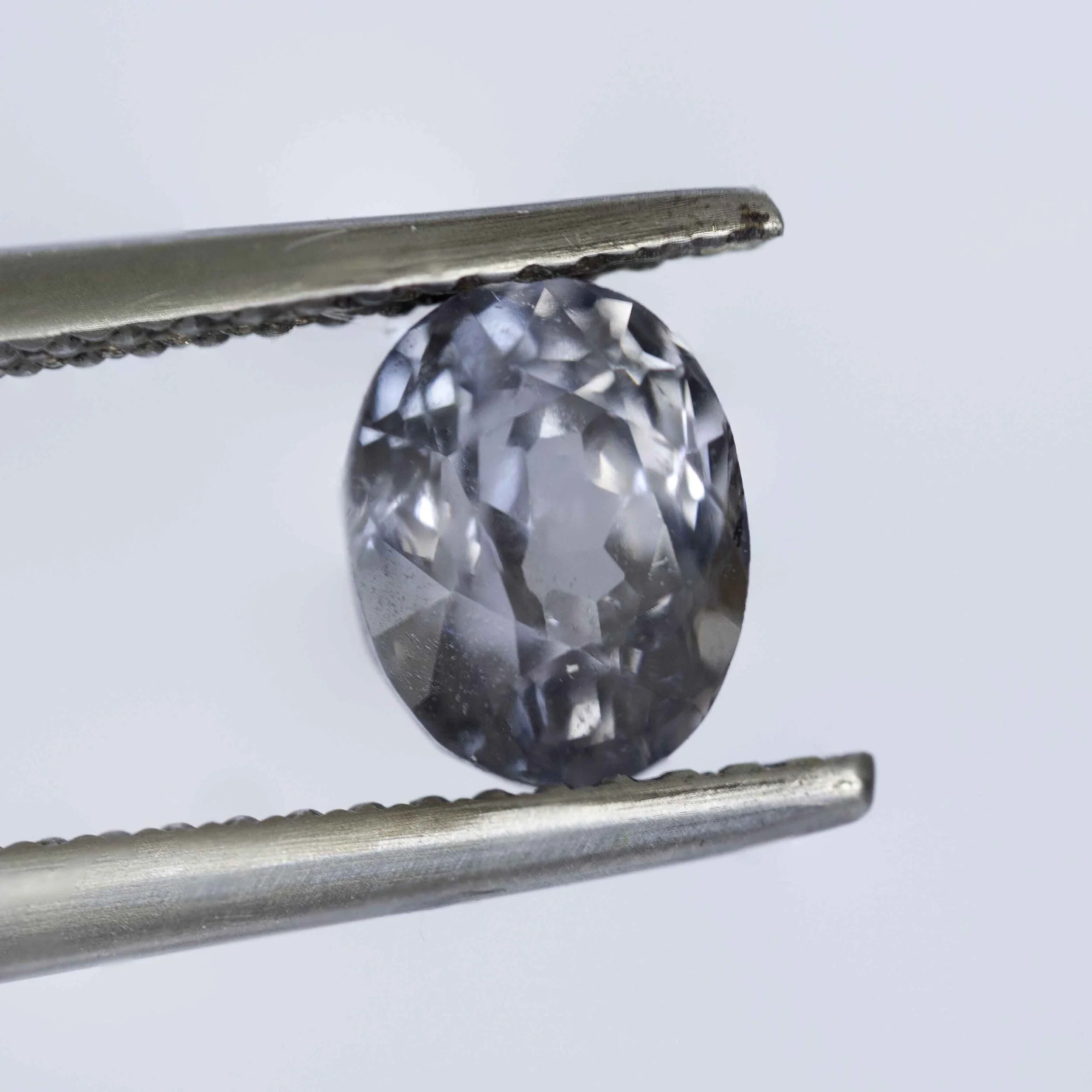
Grey Spinel meaning
As one of the oldest known gemstones, spinels have had many meanings and beliefs attached to them, though as it has only recently been recognised as a distinct gemstone, many of these are confused with rubies and other gemstones.
The name itself comes from the Latin word ‘spina’ and this refers to the way the crystals grow, in a spine-like or spike formation.
In some circles, spinels are strongly associated with cleansing, creativity, and inspiration.
Grey, as a colour, is often said to be the colour of control and compromise. It sits between the two extreme ends of the colour spectrum, black and white, and it offers a subtle canvas to add emotion and drama too.
Graphic designers use tones of grey to convey authority and to create a sense of expectation. In jewellery rendering, we use grey paper as the backdrop as it allows white highlights to be bright and lowlights to be dark to create a sense of depth in our 2D jewellery illustrations.
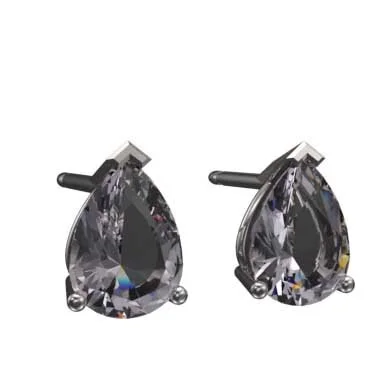
Grey spinel jewellery
The cool colour palette of a grey spinel lends itself well to a white metal setting, like silver, platinum or white gold, so most grey spinel jewellery will be made in designs made with these metals. White or black diamonds are also frequently paired with them, as are blue and purple stones like topaz or amethyst.
As Spinels measure 7.5-8 on the Mohs scale of hardness they are suitable to wear in any type of jewellery (necklace, earrings, bracelet), with the exception of rings that will be worn continuously like an engagement ring. If a spinel is worn continuously, it will need to be recut after a while to bring it back to its best. This will mean losing some of the stone’s original weight.
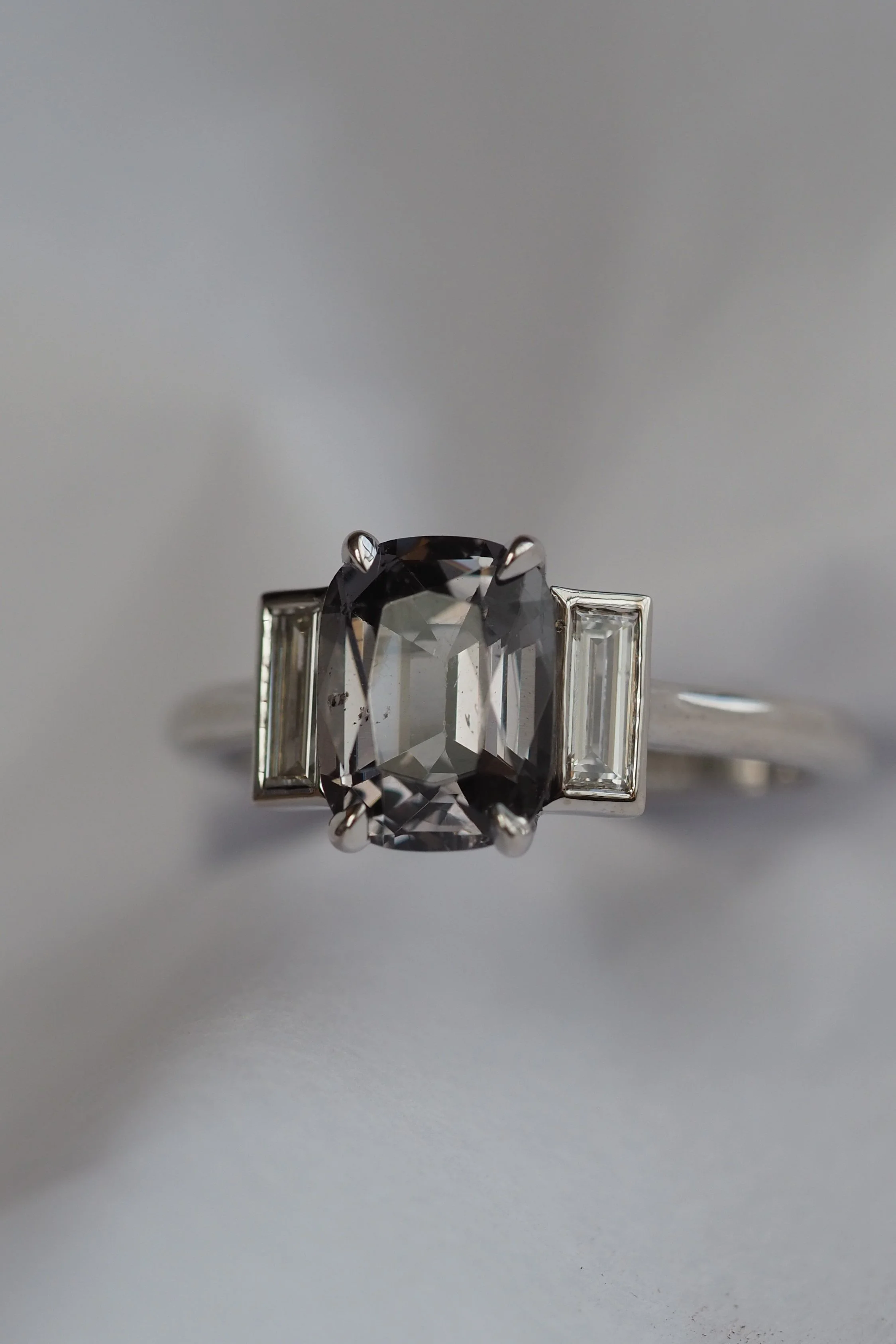
Below, you can see an example of a bespoke grey spinel ring design from our catalogue of jewellery renders. We have used a cushion-shaped grey spinel for this design, surrounded by round diamonds in a white gold setting. The diamonds are grain set with what’s known as a ‘mill grain edge’. If you want to view more from our catalogue of jewellery designs, you can click on the image below or click here. If you would like to contact us to commission a bespoke jewellery design of your own then please use this contact form.
Grey spinel’s origin
Most of the grey spinels on the market today are from Myanmar, formerly Burma. Stones from this region tend to have the most recognisably steely grey colour. Sri Lanka and Tanzania are also sources of grey spinel, however these stones tend to err more towards either the blue or purple end of the grey colour scale.
Tanzania is more famous or red spinel and Sri Lanka purple spinel, though new deposits and found frequently.
In Myanmar, spinels are found in primary marble and secondary alluvial deposits in the Mogok valley region.

Grey spinel diamond ring render
Grey spinel mining
As spinels are found in 2 different types of deposits, different types of mining methods are used. Primary marble deposits are reached by drilling and blasting tunnels to create what are known as closed pit mines. While secondary alluvial deposits, which are often located 6-7 metres below the surface are reached by digging shafts in the soil/gravel at a maximum depth of 30m.
Primary deposits require operations that have enough funding to acquire drilling equipment and explosives where as alluvial mines can be small in scale and require minimal resources and equipment or larger operations an use machinery like excavators and diggers.
Both types of mining consume large quantities of water and electricity.
Ethical grey spinel
Unfortunately, Myanmar, the primary source of grey spinels, is one of the most contentious regions in the world for ‘ethical’ gemstone sourcing. The Mogok area of the country, where most of the gemstone mining is done, is off-limits to most visitors and, as a result, conditions in the mines are unknown or at least unverifiable.
As well as the impact that mining has on the environment and the pay and working conditions of miners, the government of Myanmar has received widespread international criticism for its treatment of the Uiger ethnic minority. As the government controls the areas where gemstones are mined and profits from their sale, it can be said that some of the proceeds from the sale of spinels from Myanmar help to fund a government that has been accused of violence of suppression of ethnic minorities within their country.
Spinels from Tanzania are often mined in very basic conditions and many people in the country rely on small scale gemstone mining to make a living, in a country with a generally low level of economic development. Tanzania has a relatively well-developed gemstone mining sector and, although tracing the stone to the exact mine it came from is difficult, spinels from Tanzania are not associated with human rights abuses and oppression.
In recent years, the government of Tanzania has become more involved in helping to develop and formalise the countries mining sector.
Today, the best option for ethically mined grey spinel come from Sri Lanka. This does not mean that by definition grey spinels mined in Sri Lanka are ethical, however, there are mines in the country that uphold high standards and are transparent.
Nineteen48, a company based in the UK and Sri Lanka are the primary source for ethically mined grey spinel.
How do I know if a Spinel has been ethically mined or not?
This is very tricky and even today a lot of this relies on trust. The first questions you need to ask is where the stone is from. As mentioned above, specific regions have specific conditions which affect whether the stones can be considered ethical or not.
If the vendor doesn’t even know the country the stone is from, then there’s no way they can know under what conditions the stone has been mined, manufactured or which hands it’s passed through on it way to you. If they haven’t bothered to enquire about the origin of the products they sell, then it’s reasonable to assume they are not concerned with ethical sourcing.
If they are able to tell you which country to stone is from, then feel free to enquire if they know which mine and what conditions are like there; you can also ask where the stone was cut. The degree to which the vendor can answer these questions will vary and, to an extent, you have to use your smarts to analyse exactly what they do know or not.
Given the lack of a widely recognised system for tracing coloured gemstones, being aware and inquisitive is the best you can do where ethical spinels are concerned.
In many ways, this very modern gemstone trend encapsulates the best and worst of the current coloured gemstone supply chain.


